Symposium
November 26, 27 & 28 | 11 a.m. to 1 p.m.
Sovereign Stitches + Wild Weaves LIVE: Making & Museums Symposium
At the Museum + Online | Free – Reservation required
Curated by Wanda Nanibush and Sage Paul. Co-presented by Indigenous Fashion Arts and thinking through the museum (TTTM).
This activity is part of the Sovereign Stitches + Wild Weaves launching week activities.
Information
- Series of talks presented on Thursday, November 26, Friday November 27, Saturday November 28, from 11 a.m. to 1 p.m.
- Free activity, in English.
- Location: J.A. Bombardier Theatre, McCord Stewart Museum
- Space limited, reservations required for each day
Program:
|
Day 1 | Thursday, November 26 |
||
| 11 a.m. | Making by Hand & the “Contemporary” | Featuring: Hannah Claus, Ursula Johnson, Dr. Miranda Smitheram, Jaad Kuujus (Meghann O’Brien) and Olivia Whetung. |
| 12 p.m. | Communities & Creativity | Featuring: Maureen Gruben, Michèle St-Amand and Marley Morgan |
|
Day 2 | Friday, November 27 |
||
| 11 a.m. | Disrupting Collections | Featuring: Barry Ace, Sonya Kelliher-Combs, Léuli Eshrǎghi and FAFSWAG members Moe Laga and Elyssia Wilson-Heti |
| 12 p.m. | Patterns & Making | Featuring: Ursala Hudson, Curtis Oland, Sage Paul and Cheyenne John Schlup |
|
Day 3 | Saturday, November 28 |
||
| 11 a.m. | Perfomance & Futurity | Featuring: Michelle McGeough, Caroline Monnet, Skawennati and Pati Tyrell |
| 12 p.m. | Design & Decoding Museums | Featuring: Dr. Heather Igloliorte, Mathew Nuqingaq, Suzanne Tamaki and Jennifer Younger |
Day 1 - Thursday, November 26
Making by Hand & the “Contemporary” - 11 a.m.
Making by Hand & the “Contemporary” brings together Indigenous artists to consider how making by hand shapes, challenges, and expands understandings of the contemporary within an art museum context. Through beadwork, weaving, textiles, performance, and material experimentation, the panellists explore the relationships between ancestral knowledge, cultural continuity, technology, ecology, and contemporary artistic practice. Their work shows how materials carry memory, encode knowledge, and sustain relationships across generations, connecting artistic processes to land, identity, and community. The discussion considers how Indigenous making exists across multiple time spaces, where inherited practices remain active, adaptive, and responsive to the present and into the future. This conversation brings diverse artistic and intellectual perspectives into dialogue about the significance of making by hand and how contemporary art museums understand their practice.
Meet the panelists:
Ursula Johnson is a Mi’kmaw interdisciplinary artist from Eskasoni First Nation in Unama’ki (Nova Scotia). Since graduating from NSCAD in 2006, she has exhibited nationally and internationally, with a practice grounded in performance and installation and often involving collaboration. She collaborates with her wife, Angella Parsons, as KINUK, and won the 2017 Sobey Art Award.
Hannah Claus is a Kanien’kehá:ka and English visual artist and member of Tyendinaga Mohawks of the Bay of Quinte whose work engages Onkwehon:we epistemology. An associate professor at Concordia and co-director of its Indigenous Futures Research Center, she co-founded daphne and exhibits internationally, with works in major public collections.
Dr. Miranda Smitheram (Kāi Tahu, Pākehā) is a design researcher, educator, and artist from Aotearoa New Zealand, now Associate Professor of Material Futures at Concordia University. She directs MaSH Lab and co-directs the Textiles & Materiality Research Cluster. Her research explores remediation, materiality, and decolonizing matter through textile and biofabrication practices, with a background in fashion and textile design.
Jaad Kuujus (Meghann O’Brien) is a weaver of Haida, Kwakwaka’wakw, and Irish descent living in Vancouver, BC. Her traditional names are Jaad Kuujus (Dear Woman) and Kwaxhi’laga (Smoke Coming Out The Top Of the Big House, Welcoming People to Feast and Potlatch). Rooted in the intellectual property and deeply visual language of naaxiin (Chilkat) and yelth koo (Raven’s Tail) weaving, her practice engages both natural materials and technology as living teachers, examining her relationship to time, genetic memory, Western and Indigenous knowledge systems, and ancestral connections. Her work is a prayer to her ancestors.
Olivia Whetung is a visual artist working with beads, printmaking, and digital media. Her current work focuses on ecology, biodiversity, food justice, and native presence. Her work has appeared in solo exhibitions at the Art Gallery of Mississauga (2024), OPTICA, Montreal (2022), Contemporary Art Gallery, Vancouver (2019), and Gallery 44, Toronto (2018), and has contributed to two-person and group exhibitions across Canada and the United States. She has been awarded the Ontario Arts Council Indigenous Emerging Artist Award (2020), the Joseph S. Stauffer Prize (2019), the John Hartman Award (2018), and the William and Meredith Saunderson Prize for Emerging Artists (2016). She earned her Master of Fine Arts from the University of British Columbia in 2016.
Communities & Creativity - 12 p.m.
Communities & Creativity explores the relationships between artistic practice, community, and the ways Indigenous people represent, sustain, and imagine their worlds. Bringing together perspectives from visual art and curatorial practice, the panel considers creativity as a way to affirm identity, share knowledge, and strengthen connections between people, place, and culture. Their work creates space for Indigenous people to shape how their lives, experiences, and relationships are seen and understood, challenging dominant narratives while making room for complexity, dignity, and self-determination. Together, the panellists reflect on creativity as a collective force, shaped by relationships and capable of sustaining cultural presence, knowledge, and belonging.
Meet the panelists:
Michèle St-Amand is interested in decolonizing Indigenous sexualities in visual arts through her research-creation master’s degree in art history (UQAM). She is a member of the Wendat Nation (Wendake). As a former sexologist and psychotherapist, she is developing a curatorial practice rooted in Indigenous protocols and values, based on relational ethics.
Maureen Gruben is an Inuvialuit multimedia artist from Tuktoyaktuk whose practice combines organic and industrial materials salvaged from the Arctic environment. Her work has been exhibited at the National Gallery of Canada, SITE Santa Fe, and the Museu de Arte de São Paulo, with public art installations across North America.
Marley Morgan is a proud Wiradjuri, Gamilaraay, and Ualaroi woman and photographer based on Gumbaynggirr Country in Coffs Harbour. Through her “Blak Lens” approach, she counters deficit-based stereotypes and creates authentic, dignified depictions of First Nations people. Her commercial and editorial work spans major Australian brands, and she received the inaugural global iStock Inclusion Grant to build a positive First Nations stock imagery library.
Day 2 - Friday, November 27
Disrupting Collections - 11 a.m.
Disrupting Collections explores how artists and cultural practitioners challenge the ways museums collect, preserve, and present art and cultural knowledge. Their work engages with questions of cultural sovereignty, ancestral knowledge, and the authority to determine how cultural materials are interpreted and shared. The panel considers how artistic practices can reshape conventional understandings of collecting and create alternative ways of sustaining and circulating knowledge. The discussion examines how cultural expression moves beyond institutional categories, connecting living communities, embodied experience, and contemporary technologies. The conversation considers how artists can influence the future of collections and the ways museums engage with cultural knowledge, creative practice, and the communities from which their collections emerge.
Meet the panelists:
Barry Ace is a multidisciplinary Ottawa-based artist and citizen of M’Chigeeng First Nation. His work bridges Anishinaabeg aesthetics with digital technologies and contemporary communication. Widely exhibited and collected, he received the 2015 KM Hunter Visual Artist Award and the 2025 King Charles III Coronation Medal.
Moe Laga is a South Auckland performance artist whose practice spans movement, activation, stage and screen, and collaborative visual art shown in Australia and at China’s Pingyao International Photography Festival. A graduate of the Pacific Institute of Performing Arts and MIT, she has been part of FAFSWAG since 2012 and is Mother of the house of COVEN.
Léuli Eshrāghi belongs to the Sāmoan clans Seumanutafa and Tautua and the Persian diaspora, and lives and works in Montréal. Their practice prioritizes Indigenous, Black, and Asian sensual and spoken languages alongside artistic, ceremonial, and political practices, with major works presented at Tate Modern, Kunsthalle Baden-Baden, and QAGOMA, among others. Eshrāghi is inaugural Curator of Indigenous Practices at the Musée des beaux-arts de Montréal and serves on several Indigenous arts advisory bodies, including the 2026 Toronto Biennial’s national curatorial advisory.
Sonya Kelliher-Combs is an Iñupiaq and Athabascan mixed-media artist from Alaska whose family hails from Utqiaġvik and Nulato. Her painting, sculpture, and curatorial work explore Indigenous identity, history, and materiality, blending customary and synthetic materials. A United States Artists and Joan Mitchell Fellow, she lives and works in Anchorage.
Elyssia Wilson-Heti is an interdisciplinary artist, activist, and FAFSWAG member of mixed Niuean and European heritage. She produces for FAFSWAG Arts Collective and was recently appointed creative director of Auckland Pride Festival. Her collaborative, intersectional practice spans performance, production, and advocacy.
Patterns & Making - 12 p.m.
Patterns & Making explores the relationships between patterns, materials, and the acts of making through which cultural knowledge, identity, and lived experience take form. Across fashion, textiles, and interdisciplinary art, the panellists consider how patterns emerge through observation, repetition, and relationships with land, community, and ancestral teachings. Making is both a material process and a way of knowing, shaped by the skills, choices, and knowledge carried through generations. From garment construction and textile practices to experimentation across artistic forms, the panellists examine how patterns inform creative processes, while acts of making transform and renew the meanings held within materials and techniques. Their practices reveal connections between inherited knowledge and individual expression, where tradition remains active through interpretation, adaptation, and continued use. Moderated by Sage Paul, this conversation considers how patterns and making work together to carry knowledge, express relationships, and shape contemporary Indigenous creative practices across diverse cultural and material contexts.
Meet the panelists:
Ursala Hudson (Kadusné) is an interdisciplinary artist of Tlingit, German, English, and Filipino descent and a Raven T’ak Deintaan clan member. Working in paint and textile, she addresses Indigenous feminisms, spirituality, and cultural rematriation. Her work has shown at the Smithsonian’s Renwick Gallery and Venice Biennale and is held in public collections.
Curtis Oland is a Lil’Wat-Canadian garment designer and interdisciplinary artist currently based in Vancouver, . His connection to his Indigenous Lil’Wat heritage, the supernatural, mountainous landscapes of his homeland, and his experiences as an international nomad have created a raw essence of subdued wilderness that celebrates and honours land and materiality. Oland’s work traverses the realms of art, fashion, performance, installation, film, and creative direction, having worked on collaboratively driven projects that allow for diverse and complex storytelling.
Sage Paul is an urban Denesuliné maker from Toronto and a member of English River First Nation. She founded Indigenous Fashion Arts in 2017 and serves as its Executive & Artistic Director. An award-winning maker, she upcycles fabrics and incorporates natural materials into her work.
Cheyenne John Schlup is an Anishinaabe and Swiss artist from Ebb and Flow First Nation, raised on a Manitoba bison ranch. Immersed in traditional life and Elders’ teachings, he practices tanning, sewing, beading, quilling, and carving, striving to create as his ancestors did and guided by the old ways.
Day 3 - Saturday, November 28
Performance & Futurity - 11 a.m.
Performance & Futurity explores how artists use performance, moving images, textiles, and virtual worlds to imagine futures shaped by Indigenous knowledge, identity, and possibility. The panellists consider how creative practices connect ancestral teachings and lived experience to visions of worlds yet to come. Through weaving, film, and digital environments, their work engages questions of time, transformation, gender, colonial histories, and cultural continuity. Performance activates these relationships, bringing bodies, materials, stories, and technologies together. The discussion considers futurity as something created through artistic action: informed by the past and continually shaped by experimentation, collaboration, and the reimagining of existing systems. This conversation brings diverse Indigenous perspectives into dialogue on how artistic practices make futures tangible, creating space for alternative histories and possibilities for new worlds.
Meet the panelists:
Michelle McGeough, PhD (Métis/Cree) is originally from Amiskwaciwâskahikan, in the treaty six region of what is currently referred to as Canada. Prior to accepting her current position as an Assistant Professor at Concordia University, she taught at the University of British Columbia. Dr. McGeough received her PhD in Indigenous Art Histories from the University of New Mexico. Her research interests have focused on the Indigenous two-spirit/Indigiqueer identity.
Caroline Monnet is an Anishinaabe and French multidisciplinary artist based in Mooniyang/Montreal, originally from Aylmer. Working across visual art and film, her practice explores themes of resilience, and transformation. She has exhibited internationally at institutions including the Montreal Museum of Fine Arts, the Schirn Kunsthalle Frankfurt, Institute of Contemporary Art in Boston, the Whitney Biennial, Baltimore Museum of Art and National Gallery of Canada. Her films have screened at the Toronto International Film Festival, Sundance Film Festival, and Berlin International Film Festival. Monnet is the recipient of numerous awards and international fellowships. Her artworks are part of prominent collections across North America and internationally, including the Maison de l’UNESCO in Paris. Caroline Monnet is represented by Blouin Division in Montreal and Toronto.
Skawennati makes art that addresses history, the future, and change. Her machinima and machinimagraphs (movies and still images made in virtual environments), sculpture and textiles have been presented internationally. A Kanien’kehá:ka (Mohawk) of Kahnawà:ke residing in Montreal, she co-directs Aboriginal Territories in Cyberspace.”
Pati Tyrell is a Samoan interdisciplinary artist with a strong focus on performance. They use lens-based media to create visual material centred around ideas of urban Pacific queer identity. They have shown work at Museum of Contemporary Arts Australia, Pingyao International Photography Festival, Centre Pompidou Paris, and was a 2018 Walters Prize nominee. Tyrell is a co-founder of the queer Pasifika arts collective FAFSWAG, who in 2020 received an Arts Foundation Laureate, and in 2022 showed at the documenta fifteen in Kassel, Germany.
Design & Decoding Museums - 12 p.m.
Design & Decoding Museums explores how Indigenous artists interpret, challenge, and reshape the systems through which cultural knowledge is displayed, classified, and understood. From jewellery and ceremonial objects to fashion, photography, and moving image, the panellists consider how design carries knowledge and how museums frame its meaning. Bringing together artistic practice and curatorial experience, the conversation examines the relationships between Indigenous visual languages, cultural authority, and institutional representation, asking how Indigenous knowledge can shape the ways museums collect, interpret, and present cultural work.
Meet the panelists:
Dr. Heather Igloliorte is an Inuk-Newfoundlander curator and art historian from Nunatsiavut whose work centres circumpolar Inuit and Indigenous arts while decolonizing institutions. She co-curated Qaumajuq’s inaugural exhibition, led the Inuit Futures project, and was the first Indigenous person awarded the Royal Canadian Academy of Arts Medal.
Mathew Nuqingaq is a renowned Iqaluit silversmith, sculptor, drummer, photographer, and educator who founded Aayuraa Studio. He taught jewelry at Nunavut Arctic College, helped create the Nunavut government’s 1999 ceremonial mace, and co-founded the Nunavut Arts and Crafts Association.
Suzanne Tamaki (Ngāti Maniapoto, Tūhoe) is an artist and social provocateur working across fashion, photography, and moving image. Her practice critiques the colonial gaze and Western ideas of nationhood, exploring Indigenous feminisms in Aotearoa. Recent exhibitions include A Bloody Encounter (Pātaka Art + Museum, Porirua, Aotearoa, 2019) and Pacific Sisters: Fashion Activists (Te Papa Tongarewa, 2019). Together with Pacific Sisters, Suzanne exhibited in the 24th Biennale of Sydney. Tamaki received the inaugural Kiingi Tuheitia Portrait Award for her work Cultural Preservation, which was exhibited at the New Zealand Portrait Gallery, Wellington (2021).
Jennifer Younger was raised in the Southeast Alaska town of Yakutat, surrounded by nature and traditional ways of life. She is Tlingit of the Eagle Kaagwaantaan clan and now calls Sitka, Alaska, home. Jennifer draws inspiration from traditional Tlingit formline designs, historic artifacts, spruce root basket weaving patterns, and the contrast and texture of metals. She continually pushes the boundaries of her medium. Each piece of jewellery is handmade and assembled by her. Every engraved creation is unique, as she does not use patterns. Jennifer is a widely published, award-winning artist with honours from Evergreen State College in Washington, the Indigenous Fashion Arts Gala, the Northwest Coast Juried Art Show, the SWAIA Juried Art Show, and more.

Opening Week
From November 26 to 29
Sovereign Stitches + Wild Weaves | LIVE
Fashion, performance, symposium and more! Participate in a series of activities to celebrate the opening of the exhibition Sovereign Stitches + Wild Weaves.
Discover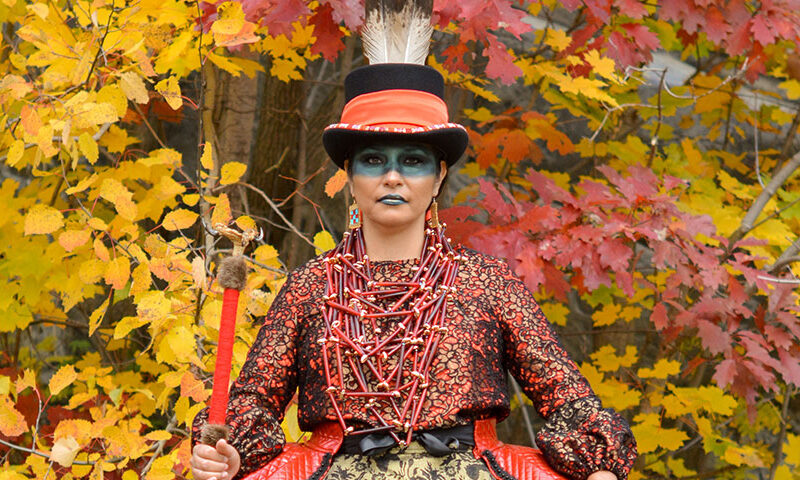
Exhibition
As of November 26
Sovereign Stitches + Wild Weaves
Sovereign Stitches + Wild Weaves, curated by Wanda Nanibush and Sage Paul, brings together nearly 40 Indigenous artists from more than 30 Nations whose work challenges the borders between contemporary art, culture, fashion, design, and customary practices.
Discover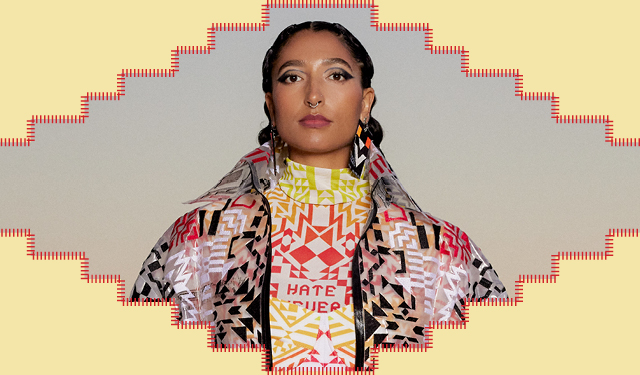
Presented by




Official Hotel Partner

Official airline

Thanks to our partners





Indigenous Fashion Arts founding partners



Be an insider!
Subscribe to our newsletter to get the inside scoop on upcoming exhibitions and cultural events.
Subscribe nowEasy access to the Museum
Parking nearby ($) • Bike and Bixi • Bus 24 • McGill Metro
More information