
Sovereign Stitches + Wild Weaves
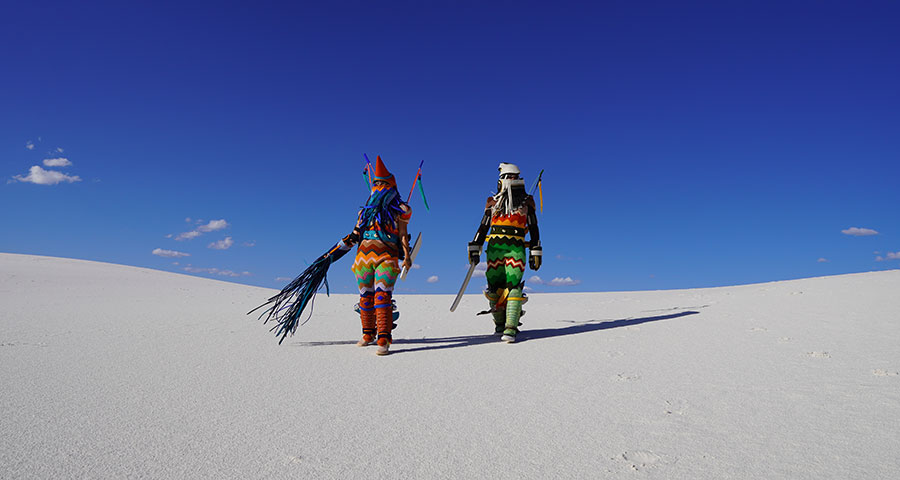
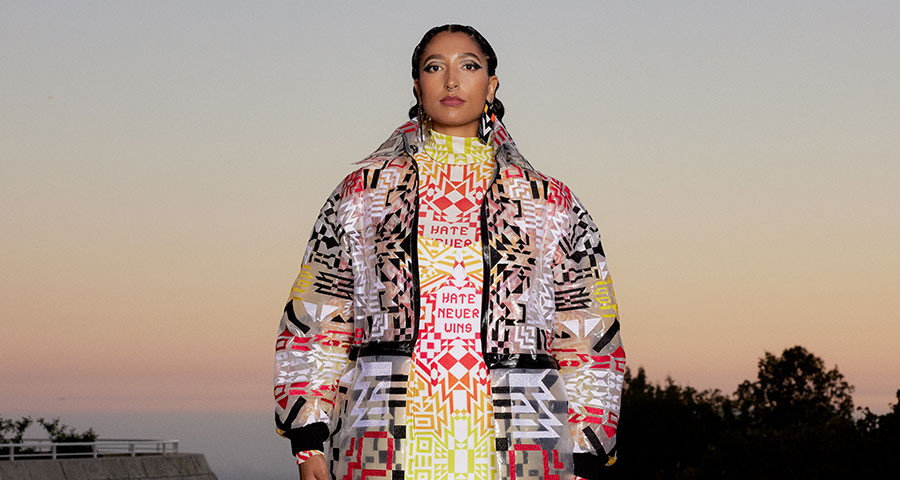
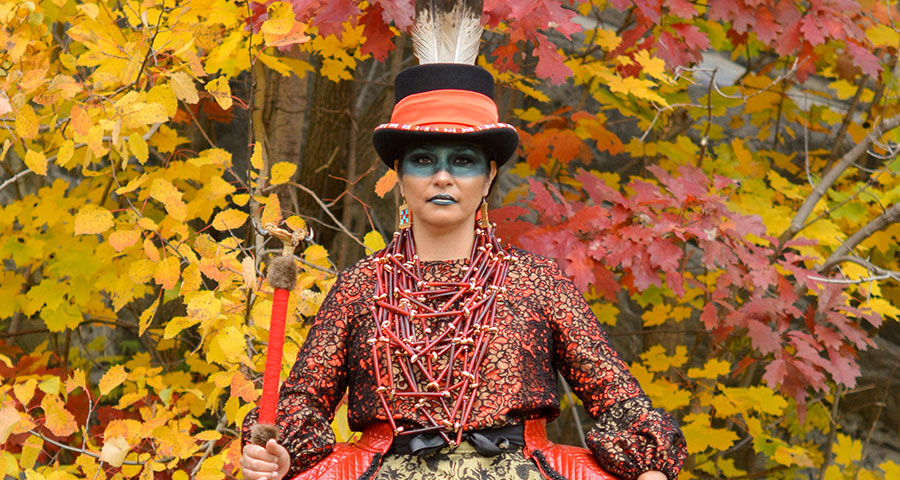
Sovereign Stitches + Wild Weaves, curated by Wanda Nanibush and Sage Paul, brings together 39 Indigenous artists from more than 30 nations who are creating significant narratives, images, and new material relations that offer a profound new understanding of the role of art in our times. These lodestars are forging a path that challenges the borders between contemporary art, fashion, craft and traditional practice. Indigenous art includes all of these modes of production and dissemination.
Art as a sign of the creative agency and imagination of individuals or groups has always been central to Indigenous societies for the purposes of adornment, beautification, storytelling, record keeping, history, political agreements, humour, ceremony, healing, entertainment, mapping, and abstract design.
In honouring an Indigenous understanding of art, Sovereign Stitches + Wild Weaves becomes a treatise on the centrality of creation to kinship and vice versa and forefronts the notion of building ancestral futures from within Indigenous notions of time.
Here you will find a love of play, dance, queer ancestors, water/earth protection, dreams, materiality, animal kin, tipi dresses and big beaver lips.
Artists
Barry Ace • Joi T. Arcand • Angel Aubichon • Christi Belcourt • Rebecca Belmore • Catherine Blackburn • Michel Dumont • Korina Emmerich • FAFSWAG • Teri Greeves • Maureen Gruben • Martine Gutierrez • Lesley Hampton • Cannupa Hanska Luger • Ursala Hudson • Ursula Johnson • Jaad Kuujus (Meghann O’Brien) • Sonya Kelliher-Combs • Yuki Kihara • Ema Lyon • Meryl McMaster • Kent Monkman • Caroline Monnet • Nadia Myre • Darlene Naponse • Shelley Niro • Mathew Nuqingap • Curtis Oland • Taqralik Partridge • Celeste Pedri-Spade • Rosanna Raymond • Cheyenne Schlup • Suzanne Tamaki • Maggie Thompson • Elina Waage Mikalsen • Scott Wabano • Olivia Whetung • Nico Williams • Jennifer Younger
About the curators
Wanda Nanibush
Wanda Nanibush is a prolific and award-winning Anishinaabe curator, author, community organizer and public intellectual living in Beausoleil First Nation. Currently, she is part of the curatorial team for Counterpublic 2026, St.Louis’ Triennial and the co-curator of Sovereign Stitches + Wild Weaves at the McCord Stewart Museum, Montreal. She was the Helen Frankenthaler Visiting Professor in Curating in the Ph.D. Program in Art History at CUNY, NYC, 2025-2026. Her exhibition Sovereign Acts III was at their James Gallery in 2026. She was also the Barker Fairley Distinguished Visitor and a sessional lecturer in the Masters of Visual Studies program, John H. Daniels Faculty of Architecture, Landscape, and Design at the University of Toronto, 2025/6.
Nanibush is the founding director of aabaakwad, an international yearly gathering of over 80 Indigenous curators, writers, and artists for talks and performances. She has curated survey, group, and retrospective exhibitions including: Radical Remembrance: The Sculptures of David Ruben Piqtoukun; Robert Houle, Red is Beautiful; Rebecca Belmore, Facing the Monumental; Rita Letendre, Fire & Light; and Toronto: Tributes + Tributaries, 1971 – 1989. She won the 2023 Toronto Book Award for her co-authored book Moving the Museum which chronicles some of her groundbreaking work at the Art Gallery of Ontario as the Inaugural curator of Indigenous Art, and co-head of Indigenous & Canadian Art.
Nanibush received her M.A. in Visual Studies from University of Toronto. She is Adjunct Faculty at York University. She won the Mid-Career Award for Curatorial Excellence in Contemporary Art, The Hnatyshyn Foundation, 2024. Nanibush has published widely on Indigenous art, politics, history, feminism and sexuality.
Sage Paul
Sage Paul is an urban Dënesųłiné woman from Toronto and a member of English River First Nation. Sage is an award-winning artist & designer working in Indigenous fashion, craft and textiles. Her work centres family, sovereignty and resistance for balance. She is also the Executive & Artistic Director of Indigenous Fashion Arts, which she founded in 2017. Sage has been instrumental in establishing and leading projects for Indigenous artists working in fashion through several projects with Indigenous Fashion Arts (formerly Indigenous Fashion Week Toronto), Nuit Blanche Toronto, the Royal Ontario Museum, IKEA Canada, the International Fashion Showcase during London Fashion Week, Setsuné Indigenous Fashion Incubator, the Canadian Trade Commissions in Milan, Mexico, South Africa and London, Artscape Launchpad and Canadian department store Simon’s.
Sage has contributed to InStudio Magazine (Banff Centre for the Arts), Walker Reader (Walker Arts Centre) and TEDx Toronto and has provided consultation for Toronto Metropolitan University, Urbani_T, Canadian Art and Fashion Awards, Harbourfront Centre and several others, including artists in the art and fashion sectors. Sage has provided consultation and advisory services on Indigenous fashion for several groups, including OCAD University, Toronto Metropolitan University, the World Intellectual Property Organization, Canadian Heritage, and the Canada Council for the Arts.
In 2022, Sage received the Changemaker Award from the Canadian Art and Fashion Awards and received a second nomination for the Premier’s Award in Creative Art and Design. In 2017, En Route Magazine recognized Sage as “… leading Canada’s Indigenous Fashion Movement.” Sage received the Design Exchange RBC Emerging Designer Award and was honoured by Ontario’s Minister of the Status of Women as a trailblazing woman transforming Ontario.
Sage calls herself a philosopher and maker. She upcycles fabrics and incorporates natural materials like raw hide and antlers into her fashion, which has been exhibited and presented in various group shows. Sometimes she retails it too. But making is her favourite part.
About the artists
Barry Ace
Barry Ace is a practicing visual artist living in Ottawa. He is a debendaagzijig (citizen) of M’Chigeeng First Nation, Manitoulin Island, Ontario. His practice embraces the impact of the digital age and how it exponentially transforms and infuses Anishinaabeg culture with new technologies and new ways of communicating. His work bridges the precipice between historical and contemporary knowledge, art, and power, while maintaining a distinct Anishinaabeg aesthetic that connects generations. He has exhibited in numerous group and solo exhibitions and is included in important public and private collections in Canada and abroad, including the National Gallery of Canada, the Canadian Museum of History, the Art Gallery of Ontario, the Nordamerika Native Museum, Global Affairs Canada, TD Bank Art Collection, Crown-Indigenous Relations and Northern Affairs Canada, the Canada Council Art Bank, and the McMichael Canadian Art Collection.
Joi T. Arcand
Joi T. Arcand is an artist from Muskeg Lake Cree Nation, Saskatchewan, Treaty 6 Territory, currently residing on unceded Algonquin territory in Ottawa, Ontario. She received a Bachelor of Fine Arts degree from the University of Saskatchewan in 2006 and a Bachelor of Arts from University nuhelot’įne thaiyots’į nistameyimâkanak Blue Quills in nêhiyawêwin in 2024. In 2018, Arcand was shortlisted for the prestigious Sobey Art Award. Her practice includes installation, photography, and design, and is characterized by a visionary and subversive reclamation and indigenization of public spaces through the use of nêhiyawêwin and syllabics.
Angel Aubichon
Angel Aubichon is a Cree-Métis designer and co-founder of Indi City. She was born and raised in Northern Saskatchewan and is part of the Peepeekisis Cree Nation. In 2017, Aubichon co-created The Matriarch Speaks, a Woman’s Traditional regalia that integrates fibre-optic technology with Indigenous design and regalia, positioning her among Indigenous artists and designers exploring the intersections of wearable technology, cultural practice and contemporary fashion. A multidisciplinary wearable art designer, Aubichon attributes her matriarchal lineage as the blood-memory drive behind her artistic expression. Bringing together traditional art practices, contemporary design, and technology, Aubichon serves as a visual storyteller speaking to the current indigenization of Turtle Island. Her wearable tech has appeared in national and international exhibitions and runways.
Christi Belcourt
Christi Belcourt (apihtâwikosisâniskwêw (Métis) / mânitow sâkahikanihk, descended from Lac Ste. Anne Métis) is a visual artist, environmentalist, social justice advocate, and avid Cree language learner. She is best known for her large, painted floral landscapes of Métis beadwork.
Christi is a visual artist with a deep respect for the traditions and knowledge of her people. Like generations of Métis artists before her, she celebrates the beauty of the natural world while exploring nature’s symbolic properties. She is mostly known for her visual arts practice as a painter. Her works are found within many public and permanent collections across North America, including the National Gallery of Canada, the Art Gallery of Ontario, the Gabriel Dumont Museum, the Thunder Bay Art Gallery, and the Minneapolis Institute of Art, among others. She was named Aboriginal Arts Laureate for 2014 by the Ontario Arts Council. In 2016, she received both the Premier’s Award for Excellence in the Arts (Ontario) and a Governor General’s Award for Innovation. In 2023, she received two honorary doctorates: Visual Arts, Algoma University (Sault Ste. Marie) and Doctor of Letters, Wilfrid Laurier University (Waterloo). In 2025, she was featured on a Canadian stamp honouring Indigenous leaders in their fields, and received an honorary doctorate from OCAD University. Most recently, in 2026, she was named a Member of the Order of Canada.
Christi has co-organized several large, national community-based projects of note, including Walking With Our Sisters (2012–21), a national touring commemoration to honour the lives of murdered and missing Indigenous women, girls, and Two-Spirit people; the Willisville Mountain Project (2010–13), a community arts project which resulted in Vale Mining agreeing not to quarry Willisville Mountain; and various works with the Onaman Collective and Nimkii Aazhibikong, a year-round, land-based arts and language space in Northeastern Ontario.
Rebecca Belmore
Rebecca Belmore (b. 1960) is a recognized multidisciplinary artist living in Thunder Bay, Ontario. Her work, rooted in Indigenous social and political realities, explores connections among bodies, land, and language. Her work has appeared in major touring solo exhibitions including Facing the Monumental (2018) and The Named and the Unnamed (2002), and she represented Canada at the 2005 Venice Biennale. Her international exhibitions include the Whitney Biennial (2021), the 16th Istanbul Biennial (2019), documenta 14 (2017), and the Havana Biennial (1991). She has received numerous awards, including the 2024 Audain Prize and the 2013 Governor General’s Award in Visual and Media Arts.
Belmore’s performances include: Facing the Monumental (2012), Victorious (2011), X (2010), Vigil (2002), Wild (2001), and Creation or Death: We Will Win (1991). Her sculptures and installations include Wave Sound (Parks Canada, 2017), Trace (Canadian Museum for Human Rights, 2014), and Ayum-ee-aawach Oomama-mowan: Speaking to Their Mother (performances in 1991, 1992, 1996, and 2008).
Belmore was awarded the prestigious Gershon Iskowitz Prize in 2016, the Hnatyshyn Foundation Visual Arts Award in 2009, and the Jack and Doris Shadbolt Foundation’s VIVA Award in 2004. She holds honorary doctorates from Université Laval, NSCAD University, Emily Carr University, and OCAD University.
Catherine Blackburn
Catherine Blackburn was born in Patuanak, Saskatchewan, and is a member of the English River First Nation (Denesųłiné). She is a multidisciplinary artist and jeweller whose narrative work often addresses Canada’s settler colonialism. Her work grounds itself in the Indigenous feminine and is bound by the ancestral love carried through stitching. Through stitchwork, she explores Indigenous sovereignty, decolonization, and representation. Her work has been exhibited in notable national and international exhibitions including Radical Stitch and Àbadakone at the National Gallery of Canada, the Santa Fe Haute Couture Fashion Show, Indigenous Fashion Arts, and Making Kin at the Humboldt Forum, Berlin. She has received numerous awards for her work, including the Sobey Art Award longlist (2019 and 2023), a Forge Residency Fellowship (2022), and an Eiteljorg Contemporary Art Fellowship (2021).
Michel Dumont
Michel Dumont is a queer, Métis, Two-Spirit, disabled artist and trauma survivor based in Thunder Bay, Ontario. He studied visual arts and psychology at Lakehead University (1986–92). In his words, Dumont “specializes in breathing new life into discarded vintage tile in striking mosaic pieces. I also create wearable art using packing tape, cellophane, and LED lights, as well as exploration in installation art. As a survivor of intergenerational trauma stemming from Indian Day School, my work often explores emerging themes in anti-colonial urban Indigenous and queer identities.” Dumont has exhibited widely in group and solo exhibitions in Ontario, Quebec, and Manitoba, Canada. In 2018, he was recognized as Visual Artist of the Year by Thunder Bay Arts & Heritage. He has received two residencies at the Banff Centre for Arts and Creativity (2018 and 2021), an artist fellowship at the Leslie-Lohman Museum in New York (2022), and a residency at Allan Gardens in Toronto as the 2022 Indigenous Artist in the Park.
Korina Emmerich
Artist and designer Korina Emmerich founded the slow fashion brand EMME Studio in 2015. Her colourful work celebrates her paternal Indigenous heritage from the Puyallup Tribe while aligning art and design with education. With a strong focus on social and climate justice, Emmerich’s artwork strives to expose and dismantle systems of oppression in the fashion industry and challenge colonial ways of thinking.
Emmerich has worked as a board member, special advisor, and educator with the Slow Factory Foundation, and as a board member with the Fibers Fund. She currently works as the Materials and Exhibitions Steward with Catalyst Dance.
She is the co-founder of Relative Arts, a brick-and-mortar community space, open studio, and shop that showcases contemporary Indigenous fashion and design in New York City’s East Village. Relative Arts provides a peer-run space that fosters the advancement of Indigenous futurism through collaboration, celebration, and education.
In 2025, she co-founded Indigenous New York Fashion Week and stepped into the role of executive director, launching runways for more than thirty Indigenous designers and more than sixty Indigenous models, and producing programming showcasing Indigenous excellence in music and art.
Her artwork and designs have been featured at the Metropolitan Museum of Art, the Museum of Modern Art, MoMA PS1, the Denver Art Museum, the Boston Museum of Fine Arts, Institute of Contemporary Art Boston, La Biennale d’art Contemporain Autochtone, the McCord Stewart Museum, and the Textile Museum of Canada, as well as in the pages of Vogue, Elle, InStyle, The New York Times, New York Magazine, and other notable publications. She has presented her collections at Vancouver Indigenous Fashion Week, Indigenous Fashion and Arts Toronto, the Santa Fe Indian Market’s Haute Couture Runway Show, NYFW, and Indigenous New York Fashion Week.
FAFSWAG
FAFSWAG is a critically acclaimed and award-winning Queer Indigenous arts collective from the Moana, based in Tāmaki Makaurau, Aotearoa New Zealand. We are committed to social change through arts and innovation, producing bespoke cultural activation that is cutting-edge, culturally responsive, and socially relevant.
Operating across a multitude of interdisciplinary art forms and genres, FAFSWAG artists work collaboratively to activate public and digital space, speaking to our contexts as Queer Indigenous arts practitioners. FAFSWAG Artists have mixed heritage across the Pacific, including the Cook Islands, Niue, Samoa, Tonga, and Aotearoa New Zealand.
FAFSWAG Arts Collective: Falencie Filipo, Tanu Gago, Tapuaki Helu, Nahora Ioane, Moe Laga-Toleafoa, Māhia Te Kore, Tim Swann, Pati Tyrell, Jaimie Waititi, Elyssia Wilson-Heti
Teri Greeves
Teri Greeves (Teri Greeves Beadwork) learned how to bead moccasins when she was eight years old. Her career as an artist evolved from creating traditional objects to making beadwork that tells stories of Native people today. She began beading sneakers because they provide a familiar access point for a wide audience to appreciate beadwork. She has used the medium to iconify Kiowa stories that she wanted to share with her own children. The pictorial beadwork on her Great Lakes Girls pieces depicts two jingle dress dancers. This work pays homage to her husband’s homeland, featuring Anishinaabe floral patterns and honouring the tribe’s women, the Anishnaabe Quaa.
Maureen Gruben
Maureen Gruben is an Inuvialuit artist from Tuktoyaktuk whose multimedia practice brings together organic and industrial materials, many of which she salvages from her local Arctic environment. Raised in a family of traditional Inuvialuit knowledge keepers and founders of E. Gruben’s Transport, her work is shaped by relationships to land, material, labour, and northern life. Gruben holds a BFA from the University of Victoria, as well as diplomas in fine art, creative writing, and Indigenous leadership from the En’owkin Centre in Penticton. Her work has been exhibited nationally and internationally, including at the National Gallery of Canada, RISD Museum, MOMENTA Biennale d’art contemporain, SITE Santa Fe, the Contemporary Art Gallery in Vancouver, the Rovaniemi Art Museum Korundi in Finland, the Fremantle Arts Centre in Australia, and the Museu de Arte de São Paulo. Her public art projects include installations for The Bentway in Toronto, the Herbert F. Johnson Museum of Art at Cornell University, and the Vancouver Art Gallery. Gruben was long-listed for the Aesthetica Art Prize in 2019 and the Sobey Art Prize in 2021. Her work is held in major public collections including the National Gallery of Canada, the Art Gallery of Ontario, the Vancouver Art Gallery, and the Indigenous Art Centre.
Martine Gutierrez
Martine Gutierrez (b. 1989) is an interdisciplinary artist whose practice spans photography, video, music, and performance. Through self-portraiture and cinematic tableaux, she reimagines identity as both material and method. Her body becomes a site of transformation, an instrument for examining desire and belonging.
Drawing from family archives and her multicultural heritage, Gutierrez melds autobiography with artifice. Her characters occupy a wide spectrum of archetypes—mainstream and marginal, sacred and satirical—embodying the ever-shifting terrain of nationality, gender, and sexuality. Moving fluidly across mediums, from billboards to episodic films, music videos, and magazines, she recontextualizes and reclaims the visual language of consumerism and mass media.
Performing every role in her productions—artist, subject, muse—Gutierrez collapses boundaries between creation and consumption. Through costume, staging, and narrative invention, she interrogates how identity is constructed and performed. Her work invites viewers to examine how images inevitably shape the selves we inhabit.
Gutierrez’s earlier bodies of work—Real Doll (2013), Girl Friends (2014), and Line Up (2014)—explore gender, intimacy, and fantasy, often incorporating mannequins as ambiguous characters in constantly shifting realities. Her semi-autobiographical film, Martine Part I – IX (2012 – 2016), is a meditation on personal transformation that began while she was an undergraduate student at the Rhode Island School of Design and was finished years later as a young artist in New York City. The episodic video work follows the eponymous character from Providence to New York via Central America and the Caribbean, communing with urban architecture and natural elements, such as sand, water, and air. Martine negotiates the permanent and the fleeting, moving from place to place, as she journeys towards self-discovery.
In 2018, Gutierrez produced Indigenous Woman, a 124-page magazine replete with fashion spreads, product advertisements, and a Letter from the Editor all dedicated, as Gutierrez describes it, to “the celebration of Mayan Indian heritage, the navigation of contemporary indigeneity, and the ever-evolving self-image.” Through the style and construct of the glossy magazine, Gutierrez subverts conventional ideals of beauty to reveal how deeply sexism, racism, transphobia, and other biases are embedded in our culture. This body of work has been exhibited all over the world, including the 58th Venice Biennale. In 2021, the Public Art Fund commissioned Gutierrez’s public art installation ANTIICON to be exhibited in over 300 bus shelters across New York City, Chicago, and Boston.
Gutierrez received her BFA from the Rhode Island School of Design in 2012. She is also a published musician and has produced several commercial videos. In 2025, she won a Guggenheim Fellowship. Gutierrez lives and works in New York.
In 2026, Gutierrez’s work will be included in major group exhibitions, including Guggenheim Pop: 1960 to Now at the Solomon R. Guggenheim Museum, Taking Back Our Space: Photographic Perspectives at the Museum of Modern Art, and Frida: The Making of an Icon, which opened at the Museum of Fine Arts, Houston and travelled to the Tate Modern. Gutierrez will debut a new performance in August 2026 as part of the Whitney Biennial. In June 2026, her solo show entitled Martine Gutierrez: Wunderkind opened at Huis Marseille in Amsterdam, the Netherlands. In 2024, Gutierrez’s landmark body of work ANTIICON: Apokalypsis was the focus of a solo exhibition at the Polygon Gallery in Vancouver, Canada. Recently, her work has also been featured in solo and group exhibitions at the Museum of Contemporary Art San Diego, CA (2025); National Museum of Women in the Arts, DC (2025); Crystal Bridges Museum of American Art, AR (2025); Museu de Arte de São Paulo, Brazil (2024); Museum of Modern Art, NY (2024); Los Angeles County Museum of Art, CA (2024); Whitney Museum of American Art, NY (2024); Fondation Carmignac, Hyères, France (2024); Sainsbury Centre, Norwich, UK (2024); Pérez Art Museum, FL (2023); and Smithsonian American Art Museum, DC (2023), among others.
Lesley Hampton
Lesley Hampton is an Anishinaabe artist and fashion designer focused on mental wellness and body neutrality in fashion through an Indigenous worldview. Lesley is a member of Temagami First Nation. She identifies as an adult “Third Culture Kid,” with her formative years spent in Canada’s Arctic and Atlantic regions, Australia, England, Indonesia, and New Caledonia. This amalgamation of her Anishinaabe indigeneity and international upbringing nurtured her passion for socio-cultural causes, using her work as a catalyst for research, conversation, and community building.
Cheyenne John Houle Schlup
My name is Cheyenne John Houle Schlup. I was born and raised in Manitoba, Canada. I am a member of the Ebb and Flow First Nation located near Lake Manitoba.
I was raised in the southwestern foothills of Riding Mountain National Park on a bison ranch just north of Waywayseecappo First Nation. I grew up immersed in our traditional way of life along with my younger sister Tashina. We grew up riding horses, hunting, tanning hides, and making all sorts of things, among the many other things that happen on a ranch in the prairies. A lot of our childhood was spent with the Elders of Waywayseecappo and the surrounding communities.
My mom is a proud Anishinaabe woman from Ebb and Flow First Nation and my father is Swiss from the Bern region of Switzerland. I am an Anishinaabe and Swiss man, and proud of both.
Art has always been a part of my life and I began tanning hides, sewing, beading, quilling, and carving at a very young age. The interconnectivity between the material culture and our spiritual ways, protocols, and what things represent through design was something that was deeply instilled in me. Through my parents and my unique childhood, I gained a love and appreciation for how the people long ago did things and I started to challenge myself, and continue to challenge myself as an artist to create as they did.
For me, this is the highest standard as an artist, because our people had it figured out. They were ingenious.
For me, it’s about receiving guidance from the old ways.
Ursala Hudson
Ursala Hudson, whose traditional name is Kadusné, is an interdisciplinary artist of German, English, Filipino, and Alaska Native (Tlingit) descent. She is Raven T’ak Deintaan clan from the Head House. Through her primary mediums of paint and textile, she engages fields of Indigenous feminisms and Native spirituality to address the colonial project, institutional reform, and cultural rematriation.
Raised in a household of full-time artist parents, printmaker Bill Hudson and renowned weaver Clarissa Rizal, much of Ursala’s informal education was received through osmosis. She learned the fundamentals of graphic design, Northwest Coast weaving, painting, photography, and regalia-making through material preparation and observation. Beyond her parents’ studio, Ursala learned beadwork and garment construction from her grandmothers, aunties, sister, and community members. Formally, she holds an MFA from the Institute of American Indian Arts, received under mentorship from Tanya Lukin Linklater, Jackson Polys, Anna Hoover, and Jordan Poorman Cocker.
Ursala understands art-making as a holistic practice that extends far beyond concept or product. Steeped in a worldview wherein art is the remnants of infinite, intertwined actions and players, everything from landscaping to mothering, river to cosmos, is a participant in the creative process. Therefore, we are always co-creating and our work is never the sole product of an individual. Each artwork that Ursala creates is a tribute to ancestors that came before and descendants that have yet to come.
Her works have been exhibited and activated in international spaces including the Renwick Gallery of the Smithsonian American Art Museum (Washington, DC), Indigenous Fashion Week Toronto, the SWAIA runway invitational in Santa Fe, and the Venice Biennale. Ursala’s work has been acquired by the Burke Museum, the Newark Museum of Art, the Smithsonian’s Renwick Gallery, the Gochman Family Collection, and the National Museum of the American Indian. She is a recipient of fellowships and residencies from the NDN Collective, Native Arts and Culture, the First Peoples Fund, the Institute of American Indian Arts, the Sealaska Heritage Institute, and The Church (Sag Harbor, New York). Her work has been awarded various honours including Best in Show at the Washington State History Museum’s 2021 exhibition In the Spirit.
Ursala lives (and works) on the ancestral lands of the Ute, Puebloan, Apache, and Diné in Southwest Colorado together with her two daughters, Amelie and Simone, their father, sculpture artist Chris Haas, and her father, social critic Bill Hudson.
Ursula Johnson
Ursula Johnson is a Mi’kmaw interdisciplinary artist from Eskasoni First Nation in the Unama’ki District (Nova Scotia). Since graduating from NSCAD in 2006, Johnson has exhibited work nationally at various university art galleries, provincial museums, artist-run centres, and festivals.
She has also shown internationally in China, Italy, Greece, Australia, and the United States.
Johnson consistently works within a wide range of mediums, while maintaining the foundation of her practice in performance and installation. Her work frequently employs cooperative didactic intervention, is place-based, and often includes collaboration with others. She describes her work as “changing mediums based on who I am talking to and what conversations I am trying to have.”
She also collaborates with her wife, Angella Parsons, as the artist duo KINUK. Johnson and Parsons have created works that explore notions of public versus private within the scope of the interpersonal nature of their relationship, and cultural difference and sameness.
Johnson was shortlisted for the Salt Spring National Art Prize in 2015 and the Nova Scotia Masterworks Award in 2016. She is a recipient of the Hnatyshyn Foundation’s REVEAL Indigenous Art Award (2016) and winner of the 2017 Sobey Art Award.
Sonya Kelliher-Combs
Sonya Kelliher-Combs (Iñupiaq and Athabascan) is a mixed-media artist whose family hails from the Alaska North Slope community of Utqiaġvik and the village of Nulato in Alaska’s interior. Her family, cultures, and relationship to the land influence all that she does. Growing up in a rural community, she observed and practiced time-honoured traditional women’s and collective labour—skin sewing, beading, and food preparation—which taught her to appreciate the intimacy of intergenerational knowledge and material histories. This collective knowledge deeply informs the materiality, symbolism, and structure of her artistic practice.
Through her mixed-media painting and sculpture, as well as her curation and community engagement, Kelliher-Combs offers a chronicle of the ongoing struggle for self-definition and identity in the Alaskan context. Her work’s imagery and symbolism speak to history, culture, family, and the life of her people. They also speak of abuse, marginalization, and the historical and contemporary struggles of Indigenous peoples in the North and worldwide. Likewise, the materiality of her work honours the ingenuity of ancestral practices such as hide and membrane preparation while examining how materials like plastic and oil are changing the landscape. Her use of synthetic, organic, customary, and contemporary materials moves beyond the binary divisions of Western and Indigenous cultures, self and other, and man and nature, to examine the interrelationships and interdependence of these concepts. Kelliher-Combs’s community advocacy in turn extends these conversations beyond her individual practice. Through her curatorial work, archival research, and collaborative arts initiatives, she works to create opportunities for Indigenous artists and community members engaged in social action and customary techniques.
Kelliher-Combs is a recipient of the prestigious United States Arts Fellowship, the Joan Mitchell Fellowship, the Eiteljorg Fellowship for Native American Fine Art, and the Rasmuson Foundation Fellowship, as well as the 2005 Anchorage Mayor’s Award for the Arts and the 2010 Alaska Governor’s Individual Artist Award. Her work is included in the collections of the IAIA Museum of Contemporary Native Arts, the Whitney Museum of American Art, the Denver Art Museum, the British Museum, the Anchorage Museum, the Alaska State Museum, the University of Alaska Museum of the North, the Eiteljorg Museum, the Smithsonian National Museum of the American Indian, and the Montclair Art Museum. Recent exhibitions include Arctic/Amazon: Networks of Global Indigeneity (Power Plant Contemporary Art Gallery, Toronto), Agency: Feminist Art and Power (Museum of Sonoma County, California), and Hearts of Our People: Native Women Artists (Minneapolis Institute of Art).
Kelliher-Combs lives and works in Anchorage, Alaska.
Yuki Kihara
Yuki Kihara (b. 1975) is a Japanese-Sāmoan conceptual artist living and working in Sāmoa. Her interdisciplinary art practice challenges dominant historical narratives and their sociopolitical persistence in contemporary culture. She poetically incorporates Sāmoan aesthetics and cultural codes by deploying a variety of media, including performance, sculpture, textiles, film, photography, and curation. Kihara’s projects, though often rooted in Sāmoan/Pacific communities and co-created locally, are designed to circulate, speak to, and influence local and international audiences, institutions, and discourses—without losing accountability to the community that shaped them. Kihara’s practice is widely considered to be at the forefront of contemporary Pacific art and cultural theory today.
Kihara gained prominence following her 2008 solo exhibition Living Photographs, presented at the Metropolitan Museum of Art, in New York City, which featured highlights of her interdisciplinary art practice. Following the exhibition, the museum acquired the works for its permanent collection.
Kihara’s works have been presented in numerous exhibitions, including the Gwangju Biennale (2023), the Aichi Triennale (2022), the Bangkok Art Biennale (2018), the Honolulu Biennale (2017), the Asia Pacific Triennial (2015 and 2002), and the Sakahàn Quinquennial (2013), to name a few.
In 2022, Kihara represented Aotearoa New Zealand at the 59th Venice Biennale with her solo exhibition Paradise Camp, curated by Natalie King and presented in the Arsenale to critical acclaim.
Kihara’s work is held in more than thirty permanent collections including the Museum of Modern Art, the Metropolitan Museum of Art, the Los Angeles County Museum of Art, the British Museum, the National Museum of World Cultures (Netherlands), the National Museum of Scotland, the Sunpride Foundation (Hong Kong), the Queensland Art Gallery | Gallery of Modern Art, the National Gallery of Australia, the Kaohsiung Museum of Fine Arts (Taiwan), and the Te Papa Tongarewa Museum of New Zealand.
Kihara is the recipient of more than fifty grants and awards, including the Art Laureate Award from the Arts Foundation of New Zealand Te Tumu Toi in 2021. Additionally, Kihara is the recipient of support from the Arts Council of New Zealand Toi Aotearoa, the Asia New Zealand Foundation, the Association of Social Anthropology in Oceania, the Goethe Institute, the British Council, the French Embassy in Aotearoa New Zealand, the Department of Foreign Affairs and Trade of the Government of Australia, the Ministry of Foreign Affairs and Trade of the Government of New Zealand, and UN Women, to name a few.
Cannupa Hanska Luger
Cannupa Hanska Luger is an award-winning artist and cultural innovator whose expansive creative and philosophical practice introduces new methodologies, ideas, and speculative technologies that reflect Indigenous innovation and shift collective thinking.
Born on the Standing Rock Indian Reservation in North Dakota, Luger is an enrolled member of the Three Affiliated Tribes of Fort Berthold (Mandan, Hidatsa, Arikara) and Lakota. His bold visual storytelling offers new ways of seeing our shared humanity while centring an Indigenous worldview.
With a socially engaged, interdisciplinary practice spanning public art, large-scale installation, ceramic sculpture, performance, time-based media, writing, and land-based actions of repair, Luger’s work blends critical cultural analysis with Indigenous advocacy and deep respect for the diverse materials, landscapes, and communities he engages.
Luger has been featured on the cover of National Geographic and profiled in The New York Times Magazine and Art21. He was named a Grist climate leader for driving fresh solutions to our planet’s most pressing challenges and is the recipient of numerous honours recognizing his groundbreaking work.
Luger is the 2026 recipient of the prestigious PEN/Jean Stein Book Award for SURVIVA: A Future Ancestral Field Guide. In 2025, he received a National Geographic Society Wayfinder Award and was named a National Geographic Explorer. He was awarded an honorary doctorate in fine art from Maine College of Art & Design (2025), the New Mexico Governor’s Award for Excellence in the Arts (2025), the Eiteljorg Contemporary Art Fellowship (2025), and the Ourworlds Immersive Visual Arts Award (2025).
Additional honours include the Herb Alpert Award in the Arts (2024), a Monument Lab Fellowship (2024), a Soros Arts Fellowship (2023), a Guggenheim Fellowship (2022), a United States Artists Fellowship (2021), a Creative Capital Fellowship (2020), a Smithsonian Artist Research Fellowship (2020), and the Joan Mitchell Foundation Painters & Sculptors Award (2019). Luger was also the inaugural recipient of the Museum of Arts and Design’s Burke Prize (2018).
Luger’s work has been exhibited nationally and internationally, including a Times Square Arts Midnight Moment (New York), the Sharjah Biennial 16 (United Arab Emirates), the 81st Whitney Biennial (New York), the 14th Shanghai Biennale at the Power Station of Art, the Metropolitan Museum of Art (New York), the Gardiner Museum (Toronto), Kunsthal KAdE (Amersfoort, Netherlands), the Art Gallery of Alberta (Edmonton), the Crystal Bridges Museum of American Art (Bentonville, Arkansas), and the National Center for Civil and Human Rights (Atlanta), among others.
Ema Lyon
Ema Lyon (Ngāti Porou, Scottish, English) is a fibre artist, weaver, activator, writer, product designer, business owner, and Mama of three incredible tamariki. As takatāpui, Ema’s work challenges the gender binary and explores Indigenous concepts of fluidity within gender and sexuality. Ema began her weaving journey under the guidance of Kahutoi Te Kanawa and was blessed to be mentored in her early years as a weaver by both Diggeress Te Kanawa and Christina Wirihana. As kairaranga and kaiwhatu, Ema connects with her tīpuna, bringing forth stories of her ancestors and challenging us to experience fibre works through a diverse lens.
Meryl McMaster
Meryl McMaster earned her bachelor of fine arts in photography from the Ontario College of Art and Design University (2010), and is currently based in Quebec, Canada. Known for her large-format self-portraits that have a distinct performative quality, she explores questions of self through land, lineage, history, and culture, with specific reference to her mixed nêhiyaw (Plains Cree), British, and Dutch ancestry. Meryl is a citizen of Siksika Nation in Alberta and her family is also from Red Pheasant Cree Nation in Saskatchewan.
McMaster’s work has been the subject of solo exhibitions at the McMaster Museum of Art, Heard Museum, Remai Modern, McMichael Canadian Art Collection, Montclair Museum, Musée d’art de Joliette, Urban Shaman Contemporary Aboriginal Art Gallery, Merignac Photo, McCord Stewart Museum, Canada House London, Ikon Gallery, Ryerson Image Centre, Glenbow Museum, Momenta Biennale, Museum of Contemporary Native Arts, and Smithsonian National Museum of the American Indian, among others.
Her work has also appeared in group exhibitions at the Humboldt Forum Berlin, National Museum of Women in the Arts, Cummer Museum, Museo de Arte Contemporáneo, Autry Museum, Museum der Moderne Salzburg, Amon Carter Museum of American Art, Sprengel Museum, Heard Museum, Anchorage Museum, Australian Centre for Photography, Musée national des beaux-arts du Québec, National Gallery of Canada, Minneapolis Institute of Art, Denver Art Museum, Pérez Art Museum, and Art Gallery of Alberta, to name a few.
She is the recipient of numerous awards, including the King Charles III Coronation Medal, Scotiabank New Generation Photography Award, REVEAL Indigenous Art Award, Charles Pachter Prize for Emerging Artists, Canon Canada Prize, Eiteljorg Contemporary Art Fellowship, and OCAD U Medal. She was shortlisted for the Rencontres d’Arles New Discovery Award 2019, Prix de la Photo Madame Figaro Arles 2019, and longlisted for the 2016 Sobey Art Award.
McMaster is represented by Stephen Bulger Gallery in Toronto, and Pierre-François Ouellette art contemporain in Montreal.
Caroline Monnet
Caroline Monnet is a multidisciplinary artist of Anishinaabe and French ancestry, originally from the Outaouais region, who lives and works in Mooniyang/Montreal. Her work grapples with colonialism’s impact, updating outdated systems with anishinaabeg methodologies.
Her work has been shown in solo exhibitions, notably at the Montreal Museum of Fine Arts (Canada), Kunsthalle Schirn (Frankfurt, Germany), Arsenal art contemporain (New York, USA), Centre International d’Art et du paysage de l’île de Vassivière (France) and the University of Toronto Art Museum (Canada). The artist has also exhibited at the Whitney Biennial (New York, USA), the Toronto Art Biennial (Canada), Musée d’art contemporain (Montréal, Canada), Baltimore Museum of Art (USA), Institute of Contemporary Art (Boston, USA) and National Gallery of Canada (Ottawa, Canada), among others.
With bachelor’s degrees in sociology and communications from the University of Ottawa and the University of Granada (Spain), Monnet received the Prix Pierre-Ayot and is part of the Sobey Art Award shortlist in 2020 and in 2026. She was also the recipient of the Merata Mita fellowship from the Sundance Institute, named Compagne des arts et des lettres du Québec in 2023 and nominated as the inaugural recipient of The Thorn Prize granted by the Mackenzie Art Gallery. Her work is included in numerous collections in North America and at the Maison de l’UNESCO in Paris. Caroline Monnet is represented by Blouin Division in Montreal and Toronto.
Kent Monkman
Kent Monkman is an interdisciplinary Cree visual artist. A member of ocêkwi sîpiy (Fisher River Cree Nation) in Treaty 5 Territory, Manitoba, Canada, he lives and works between New York City and Toronto.
Monkman’s gender-fluid alter ego Miss Chief Eagle Testickle often appears in his work as a time-travelling, shape-shifting, supernatural being who reverses the colonial gaze to challenge received notions of history and Indigenous peoples. His artworks are held in the permanent collections of institutions such as the Metropolitan Museum of Art, the Denver Art Museum, the Hirshhorn Museum, the Hood Museum of Art, the Heard Museum, the Musée des beaux-arts de Montréal, the Glenbow Museum, macLYON, and the Art Gallery of Ontario. Private collections that house his works include Art Bridges, the Horseman Foundation, the Tia Collection, the Carl & Marilynn Thoma Foundation, the Forge Project, the Gochman Family Collection, and the Sobey Art Foundation.
In 2019, Monkman was commissioned as the inaugural artist to make two monumental paintings for The Met’s Great Hall Commission project. In 2023, he was appointed an Officer of the Order of Canada—Canada’s highest civilian honour—and in 2025, he received the Governor General’s Award in Visual and Media Arts.
Nadia Myre
Nadia Myre is a contemporary visual artist whose multidisciplinary practice delves into themes of resilience, belonging, transformation, and the politics of recognition. As Canadian Art describes, “Nadia Myre’s work weaves together complex histories of Aboriginal identity, nationhood, memory, and handicraft, using beadwork techniques to craft exquisite and laborious works.” Through her evocative creations, Myre explores the structures of power that shape personal and collective narratives, crafting spaces for reflection on memory, ancestral connections, and the shared fragility of the human experience. Her art resonates deeply, sparking dialogues that bridge history, materiality, and the poetics of storytelling.
A graduate of Camosun College (1995), Emily Carr University of Art and Design (1997), and Concordia University, where she earned a master’s degree in visual arts (2002), Myre has built a celebrated career spanning over two decades. Her work has been exhibited extensively in North America and internationally in the UK, France, Italy, Greece, Mexico, Gabon, and China. Her art resides in prestigious collections, including the National Gallery of Canada, the Smithsonian Institution, the Montreal Museum of Fine Arts, the Canadian Museum of History, and the Kadist Foundation, as well as in Canadian embassies in New York, London, Paris, and Athens.
Recent solo exhibitions include All This and More (Blouin Division, Toronto, 2024), Tous geste est/et politique (Fondation Guido Molinari, Montreal, 2024), [in]tangible tangles et autres œuvres (Centre Ahkwayaonhkeh, Quebec City, 2024), Ropes & Lines (Centre international d’art du paysage – Île-de-Vassivière, France, 2024), Want Ads (Macaulay + Co., Vancouver, 2024), and After the Fire, and other work (DIANA, New York, 2024). Her commissioned project Tell Me of Your Boats and Your Waters – Where Do They Come From, Where Do They Go? was featured at Edinburgh Printmakers for the 2022 Edinburgh Art Festival.
Myre has also participated in notable group exhibitions, such as Interwoven Power: Native Knowledge / Native Art (Montclair Art Museum, New Jersey, 2024), Radical Stitch (National Gallery of Canada, 2024), Native American Art Now (Sundaram Tagore Gallery, New York, 2023), and The Vibration of Things (15th Triennial of Small Sculpture Fellbach, Germany, 2022).
Her contributions to contemporary art have earned her numerous accolades, including the Emily Award (2024), a fellowship in the Royal Society of Canada (2023), the Prix Louis-Comtois (2021), and the Sobey Art Award for Canadian artists under 40 (2014). Myre was also named a Compagne du Conseil des arts et des lettres du Québec in 2019, further cementing her status as a leading voice in Canadian and international art.
Through her evocative practice, Nadia Myre continues to craft spaces for dialogue and reflection, confronting the complexities of belonging, memory, and the intersections of personal and collective histories.
Darlene Naponse
Darlene Naponse is an Anishinaabe artist from Atikameksheng Anishnawbek in Northern Ontario.
She is a writer, film director, and video artist. Her film work has been viewed nationally and internationally. She owns Baswewe Films Inc., located on the Atikameksheng Anishnawbek reserve.
Darlene has created four feature films and various short films. Her films have been screened at the Sundance Film Festival, the Toronto International Film Festival, and the imagineNATIVE Film + Media Arts Festival. Some have also been televised.
Darlene holds a Low Residency MFA in creative writing from the Institute of American Indian Arts and a BA (hons.) from Laurentian University. She was a 2017 Writers’ Trust McClelland & Stewart Journey Prize finalist for her short story “She Is Water,” published in The Malahat Review.
Her work is placed within community and the natural world. As a storyteller, Darlene seeks out imaginative images, giving truth through word, film, and art.
Shelley Niro
Shelley Niro is a Bay of Quinte Mohawk and a member of the Six Nations of the Grand River, Turtle Clan.
Niro attended a graphic arts program at Durham College in Oshawa, concentrating on photography, drawing, and art history. Years later, she attended the Ontario College of Art in Toronto, graduating with honours. In 2019, she was awarded an honorary doctorate from the Ontario College of Art and Design University, and received subsequent honorary doctorates from Western University in 2023, and Wilfred Laurier University in 2024.
Niro was the inaugural recipient of the Aboriginal Arts Award presented through the Ontario Arts Council in 2012. In 2017, she received the Governor General’s Award in Visual and Media Arts from the Canada Council, the Scotiabank Photography Award, the Hnatyshyn Foundation REVEAL Indigenous Art Award, and an Arts and Culture Award from the Dreamcatcher Charitable Foundation. In 2019, Niro was the laureate of the Paul de Hueck and Norman Walford Career Achievement Award for Art Photography. She is an honorary Elder in the Indigenous Curatorial Collective.
Mathew Nuqingaq
Mathew Nuqingaq (b. 1964) is a world-renowned silversmith, metal artist, sculptor, drum dancer, photographer, and educator. He is also owner of the Aayuraa Studio in Iqaluit, which he founded as a jewellery workshop.
Nuqingaq taught the jewellery course at Nunavut Arctic College before opening his studio, where he makes his own creations and welcomes visiting artists to work at one of the “benches.” He focuses on how to use non-traditional materials (i.e., silver, copper) to produce Inuit sculpture and jewellery.
Nuqingaq is one of six artists who created the ceremonial mace for the commencement of the Nunavut government in 1999. He is also an accomplished performer and receives annual invitations to international festivals and celebrations. Co-founder and past chair of the Nunavut Arts and Crafts Association, Nuqingaq also served on the Inuit Art Foundation’s board of directors for more than twenty years.
Jaad Kuujus (Meghann O’Brien)
Jaad Kuujus (Meghann O’Brien) is a weaver of Haida, Kwakwaka’wakw, and Irish descent living in Vancouver, BC. Her traditional names are Jaad Kuujus (Dear Woman) and Kwaxhi’laga (Smoke Coming Out The Top Of the Big House, Welcoming People to Feast and Potlatch). Rooted in the intellectual property and deeply visual language of naaxiin (Chilkat) and yelth koo (Raven’s Tail) weaving, her practice engages both natural materials and technology as living teachers, examining her relationship to time, genetic memory, Western and Indigenous knowledge systems, and ancestral connections. Her work is a prayer to her ancestors.
Curtis Oland
Originally from the Okanagan Valley in British Columbia and currently based in Vancouver, Curtis Oland is a Lil’Wat-Canadian garment designer and interdisciplinary artist. His connection to his Indigenous Lil’Wat heritage, the supernatural, mountainous landscapes of his homeland, and his experiences as an international nomad have created a raw essence of subdued wilderness that celebrates and honours land and materiality. Oland’s work traverses the realms of art, fashion, performance, installation, film, and creative direction, having worked on collaboratively driven projects that allow for diverse and complex storytelling.
Taqralik Partridge
Taqralik Partridge is an Inuk and Scottish curator, artist, and writer originally from Kuujjuaq, Nunavik. She is the former director of the Nordic Lab at SAW Gallery in Ottawa and has worked as a curator for the Art Gallery of Ontario, the Art Gallery of Guelph, and independently for various galleries.
Taqralik is a former editor-at-large for the Inuit Art Quarterly. She has performed at festivals in Canada and internationally for more than twenty years, both as a spoken word poet and an Inuit throat singer. Her visual and film work has been shown in exhibitions in North America, Australia, Norway, New Zealand, and the UK. She currently lives in Ottawa with her family.
Celeste Pedri-Spade
Celeste Pedri-Spade is an Ojibwe Anishinabekwe artist from Lac des Mille Lacs First Nation. She identifies as a “mark maker,” working primarily with textiles and photography. Celeste holds a PhD in visual anthropology from the University of Victoria and is an Associate Professor at McGill University, where she also serves as the inaugural Associate Provost of Indigenous Initiatives.
Her artistic practice honours the women in her life and explores the tactile and sensuous meanings that emerge through creative entanglements with material environments. Through material gestures, her work intervenes in settler-colonial–Anishinaabeg relations within her family’s homelands, foregrounding the ongoing presence, strength, and resourcefulness of Indigenous women. Her practice examines how material acts reinscribe Indigenous narratives upon and within Indigenous lands and bodies, contributing to ongoing decolonial praxis.
Pedri-Spade’s work has been exhibited nationally and internationally. Selected exhibitions include Future Imaginaries: Indigenous Art, Fashion, and Technology (Autry Museum of the American West, Los Angeles), Fashion Fictions (Vancouver Art Gallery), Born Celestial (Hamilton Artists Inc.), NDN Rose (Indigenous Fashion Week Toronto), Dress to Redress: Exploring Native American Material Culture (American Museum in Bath, UK), and Global Wardrobe (Kunstmuseum Den Haag).
Rosanna Raymond
Rosanna Raymond Sistar S’pacific, a.k.a. Rosanna Raymond, is an innovator of the contemporary Pasifika art scene, a long-standing member of the art collective The Pacific Sisters, and the founding member of the SaVĀge K’lub. Raymond has achieved international renown for her performances, installations, body adornment, and spoken word. A published writer and poet, her works are held by museums and private collectors throughout the UK, the US, Canada, Australia, and New Zealand. In 2018, Raymond received the CNZ Senior Pacific Artist Award acknowledging her contribution to the arts. A former Chester Dale Fellow at the Metropolitan Museum of Art in New York, she holds a Master of Philosophy degree from Auckland University of Technology, New Zealand.
Suzanne Tamaki
Suzanne Tamaki (Ngāti Maniapoto, Tūhoe) is an artist and social provocateur. Working across fashion, photography, and the moving image, she creates visual narratives that respond to cultural politics in Aotearoa. Her works often investigate the nature of Indigenous feminisms in the South Pacific, challenging the colonial gaze. Her work also critiques Western ideas of nationhood within a bicultural nation.
Suzanne is a member of the collectives Pacific Sisters and SaVĀge K’lub. Her work is held in museum collections in Aotearoa and worldwide, including Te Papa Tongarewa National Museum of New Zealand (with Pacific Sisters), the Casula Powerhouse Arts Centre (Sydney), the British Museum, the Museum of Archaeology and Anthropology (Cambridge University), and the Dowse Art Museum (Lower Hutt, Aotearoa).
Recent exhibitions include A Bloody Encounter (Pātaka Art + Museum, Porirua, Aotearoa, 2019) and Pacific Sisters: Fashion Activists (Te Papa Tongarewa, 2019). Together with Pacific Sisters, Suzanne exhibited in the 24th Biennale of Sydney. Tamaki received the inaugural Kiingi Tuheitia Portrait Award for her work Cultural Preservation, which was exhibited at the New Zealand Portrait Gallery, Wellington (2021).
Maggie Thompson
The multimedia works of Maggie Thompson (Ojibwe) expand various textile traditions’ inherited ways of being and becoming. Thompson skillfully and intuitively works with both natural and synthetic materials to address personal and universal experiences of loss, grief, and love.
Thompson’s solo exhibitions include Interactions (IAIA Museum of Contemporary Native Arts, Santa Fe, 2025–26), Loves Me, Loves Me Not (Franconia Sculpture Park, Shafer, Minnesota, 2023), and Just Friends (Bockley Gallery, Minneapolis, 2022). Her work has been featured in group exhibitions including Contemporary Anishinaabe Art: A Continuation (Detroit Institute of the Arts, 2025–26), Text :: Textile (Broodthaers Society of America, New York, 2025), The Shape of Power: Stories of Race and American Sculpture (Smithsonian American Art Museum, Washington, DC, 2025), and Sharing Honors and Burdens: Renwick Invitational 2023 (Renwick Gallery of the Smithsonian American Art Museum, Washington, DC, 2023–24).
Thompson is a recipient of the Jim Denomie Memorial Scholarship as well as grants from the Jerome Foundation, the Minnesota State Arts Board, and the Native Arts and Cultures Foundation. Her work is collected by the Minneapolis Institute of Art, the Minnesota Museum of American Art, the Minnesota Historical Society, and the Tia Collection, among other institutions.
Thompson holds a BFA in textiles from the Rhode Island School of Design (2013). In addition to her art practice, she is a curator and owns and operates Makwa Studio, a creative space and brand creating wearables that incorporate Native textile designs. Thompson is based in Minneapolis.
Scott Wabano
A Two-Spirit Eeyou, Scott Wabano grew up among the isolated Indigenous communities on the coast of James Bay, with little exposure to the fashion industry or progressive views. Scott is a social media influencer and currently serves as a National Ambassador of Hope for the organization We Matter, and was recently awarded the Inspiring Youth of the Year Award by the Cree National Youth Council. Scott’s postsecondary education in fashion arts and business at Humber College in Toronto has led him to work with fashion brands such as Vitaly Design, Manitobah Mukluks, and Lesley Hampton. Scott is also a freelance fashion stylist.
Elina Waage Mikalsen
Elina Waage Mikalsen (b. 1992) is a Sámi-Norwegian interdisciplinary artist and musician from Romssa/Tromsø, Sápmi/Norway. She works with sound, textile, performance, text, and installation. In her sound practice, she often mixes field recordings, voice, electronics, and home-built instruments. She seeks to create sonic spaces that exist somewhere between reality and fantasy, where sound is like a time machine that causes time to collapse and sets both past and future in motion.
By collecting fragments of stories, materials, and practices, she works with what lies in between. The holes that the Norwegian colonization of Sápmi has created in the form of loss of language and cultural heritage have become a starting point for imagining what these holes might represent, what matter they constitute, and how they continue to affect the people in our societies.
Olivia Whetung
Olivia Whetung is a visual artist working with beads, printmaking, and digital media. Her current work focuses on ecology, biodiversity, food justice, and native presence. Her work has been included in solo exhibitions at the Art Gallery of Mississauga (2024); OPTICA, Montreal (2022); Contemporary Art Gallery, Vancouver (2019); and Gallery 44, Toronto (2018), and has contributed to two-person and group exhibitions across Canada and the United States. She has been awarded the Ontario Arts Council Indigenous Emerging Artist Award (2020), the Joseph S. Stauffer Prize (2019), the John Hartman Award (2018), and the William and Meredith Saunderson Prize for Emerging Artists (2016). She earned her master of fine arts from the University of British Columbia in 2016.
Nico Williams
ᐅᑌᒥᐣ Nico Williams (b. 1989) is a member of Aamjiwnaang First Nation (Anishinaabe) living and working in Tiohtià:ke/Montreal. His multidisciplinary and often collaborative practice centres on sculptural beadwork, drawing on material, relational, and geometric approaches to contemporary Indigenous art. He is active in Montreal’s urban Indigenous arts community and is a member of the Contemporary Geometric Beadwork research team.
Williams received an MFA in sculpture from Concordia University in 2021 and was awarded the Claudine and Stephen Bronfman Fellowship in Contemporary Art that same year. His work has been exhibited across Canada and internationally, including at the Musée d’art contemporain de Montréal, the Montreal Museum of Fine Arts, the PHI Foundation for Contemporary Art, the MacKenzie Art Gallery, the Art Gallery of Hamilton, and the Hessel Museum of Art.
His work is held in major public collections including the Montreal Museum of Fine Arts, the Musée d’art contemporain de Montréal, the Art Gallery of Ontario, the Bibliothèque et Archives nationales du Québec, and the Ojibwe Cultural Foundation. In 2020, the SickKids Foundation commissioned his first public sculpture, the Monument to the Brave. His practice has also been featured by National Geographic and the CBC.
Jennifer Younger
Raised in the Southeast Alaska town of Yakutat, Jennifer was surrounded by nature and traditional ways of life. She is Tlingit of the Eagle Kaagwaantaan clan and now calls Sitka, Alaska, home.
Jennifer draws inspiration from traditional Tlingit formline designs, historic artifacts, spruce root basket weaving patterns, and the contrast and texture of metals. She strives to continuously push the boundaries of her medium. Each piece of jewellery is handmade and assembled by her. Every engraved creation is unique, as she does not use patterns.
Jennifer is a widely published, award-winning artist with honours from Evergreen State College in Washington, the Indigenous Fashion Arts Gala, the Northwest Coast Juried Art Show, the SWAIA Juried Art Show, and more.

Opening Week
From November 26 to 29
Sovereign Stitches + Wild Weaves | LIVE
Fashion, performance, symposium and more! Participate in a series of activities to celebrate the opening of the exhibition Sovereign Stitches + Wild Weaves.
Discover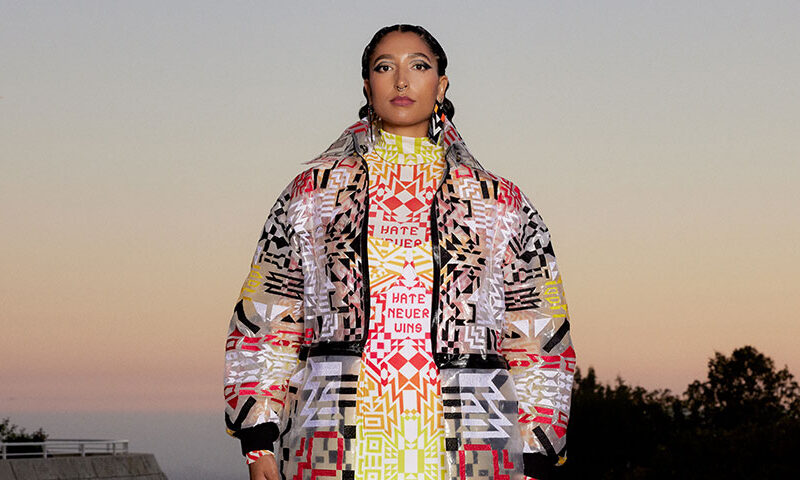
November 26 to September 6
Recommended for children aged 6 to 12.
Family trail
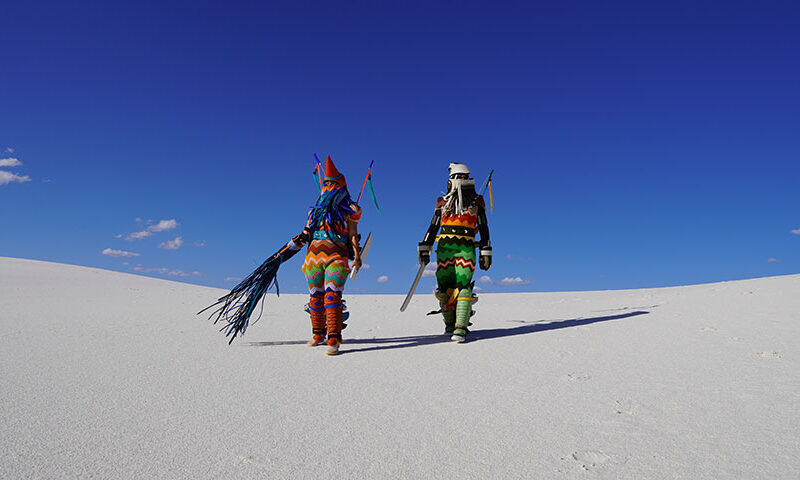
Through this trail designed for the whole family, participants are invited to explore works that tell of relationships of reciprocity, respect and interdependence between animals, plants, spirits, ancestors and the forces of the land.
From our partner
Montreal International Documentary Festival (RIDM)
From November 19 to 29, 2026, RIDM presents a bold program that offers a fresh perspective on the world and on documentary filmmaking as an art form. Over 10 days, the festival brings together established filmmakers and emerging talents, hosts discussions with artists, and creates unique opportunities for audiences to connect.
Full program and information
Presented by


Official Hotel Partner

Thanks to our partners





Be an insider!
Subscribe to our newsletter to get the inside scoop on upcoming exhibitions and cultural events.
Subscribe now