
News
February 26, 2026
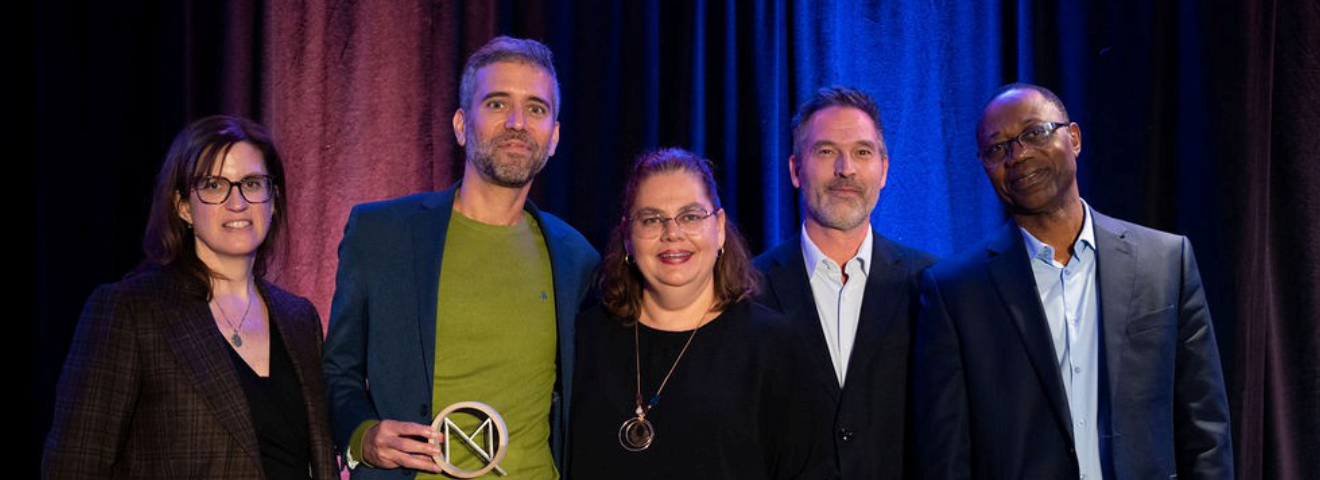
McCord Stewart Museum and its Foundation recognized for new sustainable investment policy at the 2025 Société des musées du Québec Conference
Press Release
Montreal, February 26, 2026 – For the second year in a row, the McCord Stewart Museum has received the Caisse d’économie solidaire Desjardins Award for Socio-Ecological Transition, in the Organizational Initiatives and Practices category, presented at the 2025 Société des musées du Québec Conference. This award recognizes the excellence and innovative nature of the sustainable investment policy adopted by the McCord Stewart Museum Foundation. It highlights the collective effort and sustained commitment of the entire team that helped develop and implement this policy, which integrates environmental, social and governance (ESG) principles into the Foundation’s asset management.
A policy aligned with the Museum’s values and mission
Aligned with the Museum’s 2022-2027 Strategic Plan, the sustainable investment policy reflects a clear commitment to embedding sustainability across all areas of activity. It also responds to Strategy 1.1.5 of the Museum and Foundation’s Sustainable Development Policy, which calls for responsible investment practices. By aligning financial asset management with ESG criteria and the United Nations’ Sustainable Development Goals (SDGs), this initiative strengthens the connection between the Museum’s institutional values, its social mission, and its long-term objectives. The sustainable development policy contributes mainly to SDG 16 – Peace, Justice and Strong Institutions, by promoting transparent, ethical and responsible financial governance. It also supports several other SDGs, including gender equality (SDG 5), affordable and clean energy (SDG 7), reduced inequalities (SDG 10) and climate action (SDG 13).
An innovative and collaborative approach
The development of this first sustainable investment policy reflects a spirit of innovation and leadership that remains rare in the museum sector. Not content to limit themselves to so-called “green” investments, the Museum and its Foundation have adopted a comprehensive approach that explicitly links financial decisions to their social and cultural mission. By integrating ESG criteria and Indigenous knowledge, the policy improves accountability, inclusion and the legitimacy of investment decisions, while building trust among stakeholders.
This initiative was shaped by interdisciplinary collaboration between the investment committee, the McCord Stewart Museum Foundation’s leadership team, a Museum co-head of sustainable development, and an Indigenous advisor specializing in responsible investment. This combined expertise made it possible to build an evolving policy, based on positive screening criteria and a rigorous reporting framework for portfolio managers.
Lasting impact for society
This policy reasserts the McCord Stewart Museum’s role as a cultural institution actively engaged in socioecological transition, demonstrating that financial responsibility and social impact can go hand in hand. For the Museum, the policy deepens the alignment between its social, cultural and environmental values and its financial asset management, positioning its Foundation as a model of leadership in the culture sector. It also supports stronger management of risks related to ESG issues, while advancing reconciliation and recognizing the value of Indigenous knowledge.
For communities and Museum visitors, this initiative promotes responsible investments that have a positive impact on equity, diversity, inclusion and environmental protection, while supporting the continued recognition of Indigenous knowledge.
Information and interview requests
Marc-André Champagne
Officer, Public Relations
514 861-6701, ext. 1239
marc-andre.champagne@mccord-stewart.ca

More News
-

October 10, 2024
McCord Stewart Museum doubly rewarded at the 2024 Société des musées du Québec gala
-
October 3, 2022
McCord Stewart Museum wins the Excellence award from the Société des musées du Québec
-
October 10, 2023
François Vallée, new Head, Exhibitions, receives the Prix Relève 2023 from the SMQ